
When a robot becomes a theatrical double
One of the highlights of Robophilosophy 2024 in Aarhus was not a conference paper at all, but a theatre performance. On Wednesday 21 August, the Stuttgart company MEINHARDT & KRAUSS cinematic theatre presented Replik_A … der erste Versuch at Musikhuset Aarhus. The performance brought dancer Ludger Lamers face to face with a robotic double made in his own image. Aarhus University
What struck me most was that Replik_A was not really a demonstration of a humanoid robot. It was a demonstration of what theatre can do with a robot.
A robot seen at a trade show is usually presented as a bounded technological object. We watch it walk, manipulate something, answer questions or perform a programmed routine. The implicit question is: What can this machine do?
In Replik_A, the robot is only one element in a much larger apparatus. Lighting, costume, music, choreography, puppetry, projection, screens and the architecture of the stage all participate in producing the robot as a presence. The question becomes less What can the robot do? than What can be made to happen between a human, a machine, an image and an audience?
Meeting your double
The premise is simple and very old: encountering your Doppelgänger.
Lamers meets a series of artificial versions of himself. The company describes the work as creating an “uncanny valley” on stage, populated by puppets, avatars and a humanoid robot, all doubles of the protagonist. The robot is therefore not simply another character. It is a technological version of Lamers himself. Meinhardt & Krauss
This produces an intriguing perceptual game. Lamers and his robotic double wear effectively the same red costume. Their bald heads, facial forms and body proportions are close enough that, at a distance and under theatrical lighting, the distinction is initially much less obvious than I expected.
That uncertainty is something theatre is particularly good at producing.
A robotics laboratory normally maximises visibility. Theatre does the opposite. It can selectively reveal and conceal. Bodies enter darkness. Spotlights isolate a face or hand. A scrim makes a physical performer appear almost immaterial. Distance reduces detail. Costume exaggerates similarities. Movement can be synchronised or deliberately mismatched.
In one of my photographs, Lamers stands behind a large translucent screen while his robotic double sits outside it. Although both are physically present on the same stage, the screen puts them into different ontological zones: one appears almost like an image while the manufactured body seems, paradoxically, more materially present.
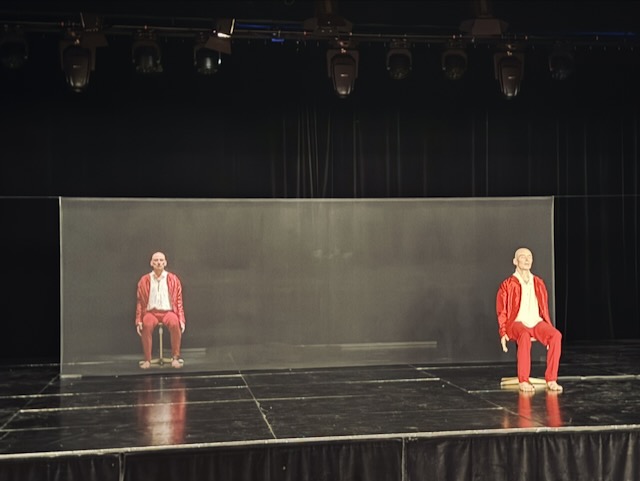
This is why trying to decide whether the robot is sufficiently “human-like” misses something important. Its human likeness is not simply contained in its silicone face. It is staged.
A robot among puppets and projections
The most interesting feature of Replik_A is that it refuses to establish a clean opposition between ‘the human’ and ‘the robot’.
Lamers is multiplied by several different media.
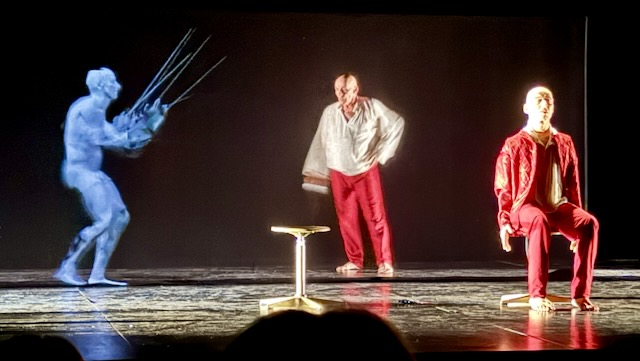
At various points his body appears as a physical performer, a robotic replica, a puppet-like figure and a projected or computer-generated body. Festival descriptions of the production explicitly place the android alongside a moving curtain, a three-dimensional computer graphic and a jester-like puppet. Figuren Theater Festival
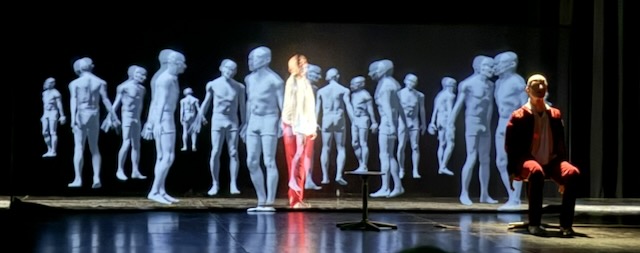
The projections are particularly effective. In one sequence, Lamers stands in front of a whole population of pale virtual bodies. There is a flesh-and-blood Ludger, a mechanical Ludger sitting nearby and many digital Ludgers occupying the screen behind them.
Elsewhere a large blue virtual double appears to duel with the human performer while the robot watches from its chair.
There isn’t really an original and a copy any more. There is a series of differently mediated bodies.
The live body has one repertoire of movements. The robotic body has another. The projected body can ignore gravity, multiply or change scale. The puppet can exaggerate and simplify. Theatre brings all of these versions into the same perceptual field.
That makes the robot more interesting, not less. It becomes one technique of animation among several.
Robotics as puppetry
There is a useful history behind this. MEINHARDT & KRAUSS are not a robotics company that has moved into theatre. They are theatre-makers with a long involvement in puppetry and technologically mediated performance.
The Stuttgart-based company has existed in its present form since 2003, centred on Iris Meinhardt, a puppeteer and director; Michael Krauss, director, video artist and robotics specialist; and Thorsten Meinhardt, composer and musician. The company describes its work as an exchange between puppet theatre, film, new media and contemporary music. Meinhardt & Krauss
That history is important for understanding Replik_A. A puppet does not need to persuade us that it is autonomously alive. Puppetry is built around a much more interesting relationship between object, manipulation and attributed agency. We know the puppet is manufactured and nevertheless find ourselves responding to it as an acting presence.
Robots extend this problem rather than replacing it.
MEINHARDT & KRAUSS had already explored robotics directly in Robot Dreams, premiered in 2019. In that production three dancers encountered automata, robots, animatronic body parts and an artificial intelligence called ToMoMi. The company’s description is revealing: programming and electricity make machine-objects appear alive, without making them straightforwardly human, animal or object. Meinhardt & Krauss
Replik_A intensifies the idea by building the machine around the body of a particular person.
Building Replik_A
Replik_A premiered on 3 November 2023. The robotic double was conceived and built by Nils Bennett and Michael Krauss, with robotic programming by Krauss. The silicone moulding and painting that give the head its strikingly human appearance were produced by sculptor Jörg Steegmüller. Meinhardt & Krauss
But the credits underline why it would be misleading to attribute the effect just to the robot builders. Iris Meinhardt directed the work and co-designed the scenography with Krauss; Lieve Vanderschaeve created the video design; Thorsten Meinhardt composed the music and sound; Katharina Ruprecht designed the costume; and Alexander Schmidt was responsible for lighting and technical work. Meinhardt & Krauss
The robot is therefore already the product of a collective before it even gets onto the stage.
That collective production continues during performance. The robot’s movements matter, but so do the stool on which it sits, the red suit that connects it visually with Lamers, the blackness around it, the timing of a light cue and the human performer who adjusts his own movements in relation to it.
In the video I recorded, small gestures become surprisingly effective: movements of the head and arms, changes of posture, a raised leg, pauses and shifts in orientation. They don’t have to reproduce the extraordinary flexibility of a human dancer. Within the theatrical situation, relatively constrained movement is enough to suggest attention, intention and personality.
This seems to me one of the important differences between theatrical robotics and the benchmark mentality that dominates robotics research. A robot does not have to reproduce the complete movement repertoire of a person to become dramatically expressive. A particular gesture, occurring at the right time and framed by the right situation, can be enough.
The stage as an agency-making machine
There is a tendency in discussions of social robots to ask whether a robot really possesses agency, intelligence, emotion or social understanding. Watching Replik_A suggests another way to formulate the problem. Agency can also be produced theatrically.
The stage organises attention. The lighting tells us where to look. Sound establishes expectation. Another performer reacts to the robot, and that reaction teaches us to recognise the machine as a participant. A pause can become hesitation. A turn of the head becomes attention. A raised hand becomes a response.
None of this makes the robot secretly human. Rather, it demonstrates how much of what we ordinarily recognise as agency depends on relationships between bodies, environments, technologies and observers. This is something puppetry has known for centuries.
Perhaps robotics has something to learn from it.
The robot in Replik_A is compelling precisely because the production does not leave it alone. It surrounds it with other techniques for producing presence: projection, animation, costume, dance, puppetry, music, darkness and illusion. Instead of asking the robot to prove that it is an autonomous performer, the production places it within a carefully composed ecology of performance.
And that may be the most interesting thing about robot theatre. A robot never simply walks onto a stage.
The stage makes a robot.
Production
Replik_A … der erste Versuch
MEINHARDT & KRAUSS cinematic theatre
Performance/dance: Ludger Lamers
Direction: Iris Meinhardt
Robotics concept/construction: Nils Bennett and Michael Krauss
Robotics programming: Michael Krauss
Video design: Lieve Vanderschaeve
Music/sound: Thorsten Meinhardt
Silicone moulding/painting: Jörg Steegmüller
Costume: Katharina Ruprecht
Scenography: Iris Meinhardt and Michael Krauss
Lighting/technology: Alexander Schmidt Meinhardt & Krauss
Performed at Robophilosophy 2024, Musikhuset Aarhus, 21 August 2024. Aarhus University
MEINHARDT & KRAUSS — Replik_A official production page
MEINHARDT & KRAUSS — About the company
A possible title I like slightly more for Following Robots is “The stage makes a robot: Replik_A at Robophilosophy 2024”. It gets the central argument into the title and distinguishes the post from a conventional review.
Leave a Reply