
Chris Chesher & Justine Humphry
Article published in Mobile Media and Communication, August 10, 2026. Available open access at: https://doi.org/10.1177/20501579261476544
Abstract
This article examines the rise of a new generation of mobile service robots that use AI for navigation and communication in public and semipublic spaces. Reviewing the state of the field of service robots and robot scholarship, this paper is a literature-informed commentary on mobile AI service robots as mobile media and their implications for human workers and the public, shared environments, and regulation in everyday spaces. We examine how mobile AI service robots are increasingly appearing in restaurants, hotels, university campuses, and public streets as service workers, tools, and social actors, introducing new modalities of communication, and reshaping spatial relationships, labour practices and power dynamics. These developments raise critical questions about the effect of robots’ communicative acts of movement, interfacing and emotional expression on others, the organisation of labour, and their role in the privatisation and surveillance of space. Ultimately, we argue that as mobile AI becomes embedded in ordinary life and work settings, it necessitates a renewed focus on who benefits, who is displaced, and how these increasingly agentic actors are governed as they become normalised in shared and public spaces.
Keywords
mobile communication, mobile AI, service robots, urban space, surveillance, human– robot interaction
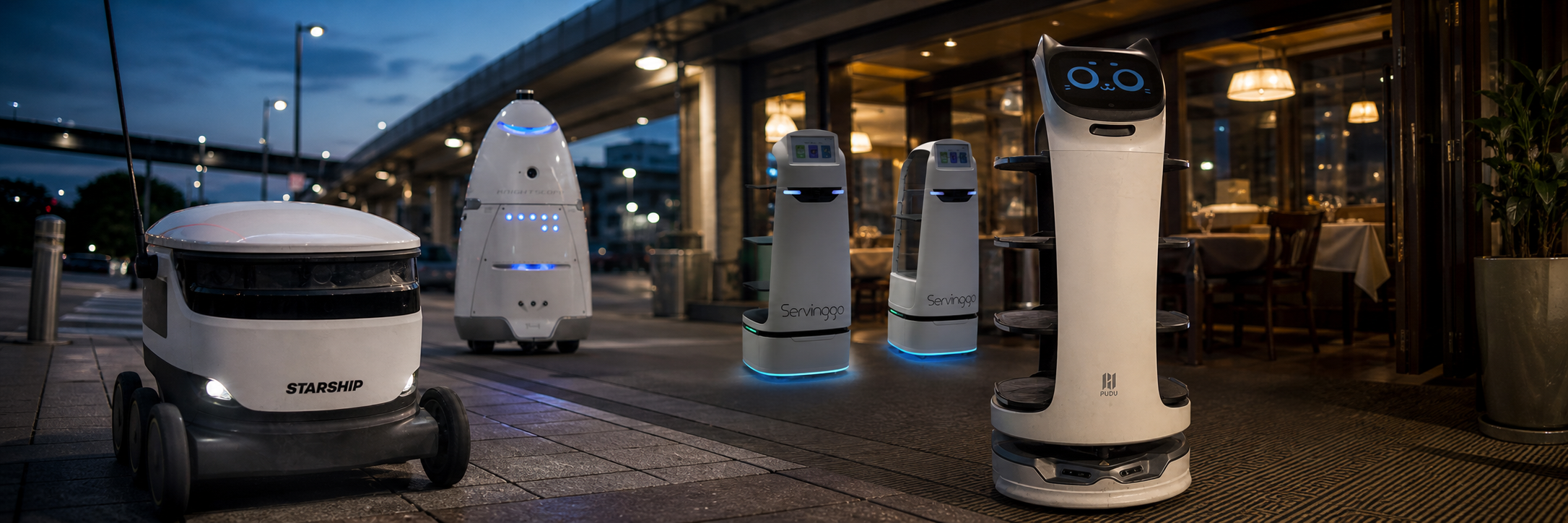
A cat-faced Pudu BellaBot robot in Kuala Lumpur moves confidently through a busy restaurant, dodging customers. When it arrives at a table, it greets the guests in a cute voice, turning to allow diners to take their food and drinks from the tray. An LG CLOi robot in Seoul, South Korea, is loaded with beer and snacks by a hotel worker, before it summons the elevator, travels down 10 floors, and moves autonomously through the corridor to deliver its package to room 308. A Starship delivery robot in Corvallis, Oregon, travels on pedestrian paths across campus, crossing streets, stopping near a residence hall, and signalling hungry students to remove their meals from its internal tray.
These scenes, captured in media reports and our own observations, are harbingers of life-worlds and urban environments increasingly traversed by mobile AI service robots moving around and communicating in an increasingly crowded public domain. Over the past ten years, various forms of service robots – enabled by AI – have been designed to manage communication, logistics, and mediation of the mobility of people and objects in different social and work spaces. According to the International Federation of Robotics (2025), the top five applications of service robots are transportation and logistics, followed by hospitality, cleaning, agriculture, and security. In this article, we examine the uptake of mobile AI service robots in everyday spaces addressing themes of power and agency with regard to their local mobilisations. While service robots have existed in some form prior to recent advances in AI, a range of AI technologies are giving them significantly enhanced capabilities in computer vision, simultaneous localisation and mapping (SLAM), route planning and voice interaction. This raises a key issue of whether these AI capabilities are a major or incremental shift in the design and operation of mobile service robots. When service robots employ AI to become mobile and social in public and semipublic spaces, they raise new questions and surface older debates about the purpose, design, norms, and governance of technologies in physical and social space. What labour do such robots perform and how do they communicate? What roles do they play in the privatisation of space and its surveillance? What is the responsibility of designers and owners of robots to share and maintain the space? In what ways do robots have a right to the city?
We address these questions through a literature-informed commentary on patterns and trends in mobile AI service robots and their uptake in a range of service sectors around the world drawing on studies and reported examples of robots in service settings including restaurants, hotels, and university campuses. Our analysis shows that these service robots are mobile communicative agents that make claims on space, transform social relationships, and intervene in labour practices. In this way, they form part of the fabric of practices, people, materials, and processes that make up the times, spaces, and infrastructures of everyday life and work (Burkitt, 2004). Because of their AI-enabled communicative and navigational capacities, we suggest that mobile service robots can be understood as mobile AI and that ideas and approaches within mobile communication scholarship grounded in the everyday can help to address some of the social and spatial challenges that accompany them.
See full open access article at https://doi.org/10.1177/20501579261476544
ORCID iDs
Chris Chesher https://orcid.org/0000-0001-9377-4512
Justine Humphry https://orcid.org/0000-0002-2376-2089
References
Bellamy, D., & Pravica, L. (2011). Assessing the impact of driverless haul trucks in Australian surface mining. Resources Policy, 36(2), 149–158. https://doi.org/10.1016/j.resourpol.2010.09.002
Bendel, O. (2023). Robots in policing. In R. Hakli, P. Mäkelä, & J. Seibt (Eds.), Social Robots in Social Institutions (pp. 135–144). IOS Press.
Bennett, C., Ackerman, E., Fan, B., Bigham, J., Carrington, P., & Fox, S. (2021). Accessibility and the crowded sidewalk: Micromobility’s impact on public space. DIS 2021 – Proceedings of the 2021 ACM Designing Interactive Systems Conference: Nowhere and Everywhere, 365–380. https://doi.org/10.1145/3461778.3462065
Brinklow, A. (2017, December 6). SF bans delivery robots on sidewalks. Curbed San Francisco. https://sf.curbed.com/2017/12/6/16743326/san-francisco-delivery-robot-ban.
Burkitt, I. (2004). The time and space of everyday life. Cultural Studies, 18(2–3), 211–227. https:// doi.org/10.1080/0950238042000201491
Chesher, C. (2013). Mining robotics and media change. M/C Journal, 16(2). https://doi.org/10. 5204/mcj.626
Chesher, C., & Humphry, J. (2025). Robots in restaurants and emotional labour: A view from the pepper parlor. In J. Seibt (Ed.), Social robots with AI – Robophilosophy 2024 proceedings (pp. 157–167). IOS Press.
De Maio, A., Ghiani, G., Laganà, D., & Manni, E. (2024). Sustainable last-mile distribution with autonomous delivery robots and public transportation. Transportation Research Part C: Emerging Technologies, 163, 104615. https://doi.org/10.1016/j.trc.2024.104615
Dobrosovestnova, A., Hannibal, G., & Reinboth, T. (2022). Service robots for affective labor: A sociology of labor perspective. AI and Society, 37(2), 487–499. https://doi.org/10.1007/ s00146-021-01208-x
Firoozi, R., Tucker, J., Tian, S., Majumdar, A., Sun, J., Liu, W., Zhu, Y., Song, S., Kapoor, A., Hausman, K., Ichter, B., Driess, B., Wu, J., Lu, C., & Schwager, M. (2025). Foundation models in robotics: Applications, challenges, and the future. The International Journal of Robotics Research, 44(5), 701–739. https://doi.org/10.1177/02783649241281508
Fortunati, L. (2019). When the new medium is a robot. In In Soziales medienhandeln: Integrative perspektiven auf den wandel mediatisierter interpersonaler kommunikation (pp. 49–58). Springer Fachmedien Wiesbaden.
Gunkel, D. J. (2018). Robot rights. MIT Press.
Guzman, A. (2018). ‘Introduction: What is human-machine communication, anyway?’ In A. Guzman (Ed.), Human-machine communication: rethinking communication, technology, and ourselves. Peter Lang, 1–28.
Hall, E. T. (1982). The hidden dimension. Anchor.
Hepp, A. (2020). Artificial companions, social bots and work bots: Communicative robots as research objects of media and communication studies. Media, Culture & Society, 42(7-8), 1410–1426. https://doi.org/10.1177/0163443720916412
Hildebrand, J. M. (2022). What is the message of the robot medium? Considering media ecology and mobilities in critical robotics research. AI and Society, 37(2), 443–453. https://doi.org/10. 1007/s00146-021-01204-1
Hochschild, A. R. (2020). The managed heart: Commercialisation of human feeling. University of California Press.
Hockenberry, M. C., Starosielski, N., & Zieger, S. (Eds) (2021). Assembly codes: the logistics of media. Duke University Press. Retrieved from http://dx.https://doi.org/10.1215/9781478013037
Humphry, J. (2025). Digital policing of homeless and other marginalised groups in smart cities: Datafication, prediction and algorithmic control. Policing and Society, 1–19. https://doi.org/ 10.1080/10439463.2025.2577225
International Federation of Robotics. (2024). Executive summary: World robotics 2024—Service robots. https://ifr.org/img/worldrobotics/Executive_Summary_WR_2024_Service_Robots.pdf.
International Federation of Robotics. (2025). Executive summary: World robotics 2025—Service robots. https://ifr.org/img/worldrobotics/Executive_Summary_WR_2025_Service_Robots.pdf.
Kanderske, M. (2023). Domesticating motile media: The routes and routines of vacuum robots. Digital Culture & Society, 9(1), 71–98. https://doi.org/10.14361/dcs-2023-090105
Kitchin, R., Lauriault, T. P., & McArdle, G. (2015). Smart cities and the politics of urban data. In S. Marvin, A. Ayala, & C. McFarlane (Eds.), Smart Urbanism (pp. 16–33). Taylor & Francis.
Kovacic, M., Marvin, S., & While, A. (2024). Regulating sidewalk delivery robots as a disruptive new urban technology. Urban Geography, 45(7), 1236–1255. https://doi.org/10.1080/02723638.2023. 2275426
Kuss, P., & Meske, C. (2025). From entity to relation? Agency in the era of artificial intelligence. Communications of the Association for Information Systems, 56, 633–674. 10.17705/1CAIS.05626 https://doi.org/10.17705/1CAIS.05626
Ling, R. (2004). The mobile connection: The cell phone’s impact on society. Morgan Kaufmann.
Mintrom, M., Goddard, P., & Sumartojo, S. (2025). Anticipatory policy design for robots in public spaces. Journal of Asian Public Policy, 1–15. https://doi.org/10.1080/17516234.2025.2511763
Morley, D. (2017). Communications and mobility: The migrant, the mobile phone, and the container box. John Wiley & Sons.
Őrsi, B., Korondi, P., Csukonyi, C., Papp, D., Márkus, P., Selejó Joó, B. T., Neamah, H. A., & Kovács, K. E. (2026). Recognition of emotions and non-verbal communication characteristics in human-robot interactions – the experience of a systematic review. Social Sciences and Humanities Open, 13, 102387. https://doi.org/10.1016/j.ssaho.2025.102387. Elsevier Ltd
Pfeifer, R., & Iida, F. (2004). Embodied artificial intelligence: Trends and challenges. Lecture Notes in Computer Science, 3139, 1–26. https://doi.org/10.1007/978-3-540-27833-7_1
Pudu Robotics. (2025). BellaBot premium delivery robot. Pudu Robotics. https://www. pudurobotics.com/my/product/detail/BellaBot.
Simon, M. (2017, December 21). The tricky ethics of Knightscope’s crime-fighting robots. Wired. https://www.wired.com/story/the-tricky-ethics-of-knightscopes-crime-fighting-robots.
Starship. (2026). Our Robots. Starship https://www.starship.xyz/our-robots/.
Sumartojo, S. (2023). Concepts for robot geographies. In T. Osborne & P. Jones (Eds.), A research agenda for digital geographies (pp. 41–52). Edward Elgar. https://doi.org/10.4337/9781802200607. 00012
Waga, A., Benhlima, S., Bekri, A., Abdouni, J., & Saber, F. Z. (2025). A survey on autonomous navigation for mobile robots: From traditional techniques to deep learning and large language models. Journal of King Saud University Computer and Information Sciences, 37(7), 198. https://doi.org/10.1007/s44443-025-00216-x
Wang, A. (2025, September 3). Top ten last mile delivery robot brands to know. Fdata. https:// www.fdatabot.com/top-10-last-mile-delivery-robot-brands-to-know/.
Leave a Reply