
GUEST AUTHOR: WILL MU
Will is a second-year PhD student at the University of Sydney researching mediated movement across cinema and robotics, currently seeking practitioners for research interviews. Contact: will.mu@sydney.edu.au
Mediated Movement: A Shared Language in Media
Cinema and robotics belong to different industries, different scholarly traditions, and different professional communities. Yet as a former film practitioner, I have observed that both practices share a fundamental challenge: producing movement through technical means. This raises a question: what role does the technical production of movement play across cinema and robotics, and what connects these seemingly unrelated practices?
This blog post introduces the concept of mediated movement. Cinema and robotics produce movement in genuinely distinct ways, but beneath the differences lies a shared operation.
Defining Mediated Movement
Mediated movement refers to movement that is constructed, encoded, or choreographed through technical systems and perceived as ‘lifelike’ across media forms.
For the producer, it is the technical fabrication of movements. The movement is no longer a performance of a human body; instead, it is technically mediated: generated and recorded in cinema, or in the case of some robots, dynamically synthesised by algorithm, or physically enacted in real time by machines.
For the viewer, mediated movements bring life into the lifeless. We look past the mechanism to perceive a life form. It requires a willing suspension of disbelief, a moment where we grant the animated figure a temporary soul that is generated by the mediated movement.
Cinema and robotics look like unrelated fields until you trace them back to the same ancestor. Before the movie camera, before the assembly line robot, there were automata: clockwork figures engineered to write, to draw, to play instruments, to produce the illusion of life through mechanical precision. Muybridge’s motion studies were not just photography; they were an attempt to decompose movement into programmable units, a logic that runs unbroken from his galloping horse to a contemporary VFX rig. The movie camera itself is a clockwork device, and the actor hitting their mark on cue, repeating a gesture across twelve takes until the system captures it correctly, is being disciplined toward a kind of mechanical consistency that has more in common with robot calibration than with spontaneous human expression. This is the provocation at the heart of mediated movement: cinema was always already robotic, and robotics has always been trying to make cinema. They are not two fields borrowing from each other; they are two expressions of the same original problem, producing movement that reads as life, one on screen, one in physical space, both inherited from the same clockwork dream.
Theoretical Frameworks
Three ideas underpin the concept of mediated movement: that animation is not exclusive to cinema, that as well as being captured, movements can also be technically produced in a written form and governed like a score.
All Films are Animation: Alan Cholodenko argued that all films are a form of animation, defined as ‘endowing with life, where various forms of energy, animism, magic, élan vital, etc., catalyze or transform the inanimate into the animate…’, (Cholodenko, 1991, p. 16). This thesis extends Cholodenko’s claims about animation beyond the frame of cinema. Unlike Cholodenko, I will address the significance of the technical means by which movement is actually produced by practioners. The concept of mediated movement continues at where Cholodenko stops: shifting from the ontological to the technical perspective, and extending the idea of animation beyond cinema. If animation can produce mediated movement, robotics is also engaged in a related but distinct way.
The Movement-Image: Among philosopher, Deleuze is unusual as he directly engages with the aesthetics of technological arts. He argues that cinema doesn’t just simulate motion; it is movement (Deleuze, 1986). While Bergson dismissed cinema as an illusion, Deleuze instead claims that the movement-image, functioning as mobile sections of duration, produces genuine movements in time rather than just a succession of still images (Deleuze, 1986). In fact, Deleuze’s insight reaches further: if cinema produces movement rather than merely capturing it, then this movement is not a property of the filmed subject but of the technical system that generates it. Then the question shifts: not which medium recorded the movement, but which technical means produced it. This is the principle of mediated movement.
Choreography: In some ways, mediated movement has some relation to the traditions of choreography. In dance, choreography traditionally means the rigorous ‘writing of movement’ (khoreia + graphein) following a score: a set of instructions that dictates the dancer’s movements. Allsopp and Lepecki (2008) argue that choreography is more about a system of command: an apparatus that captures bodies and imposes specific movement imperatives upon them. In this light, a programmer writing a loop for a robot has some similarity with a choreographer notating a ballet troupe: both are creating a system where movement is executed by an agent: in one case the organic performer and in another the algorithmic puppet.
The Two Media
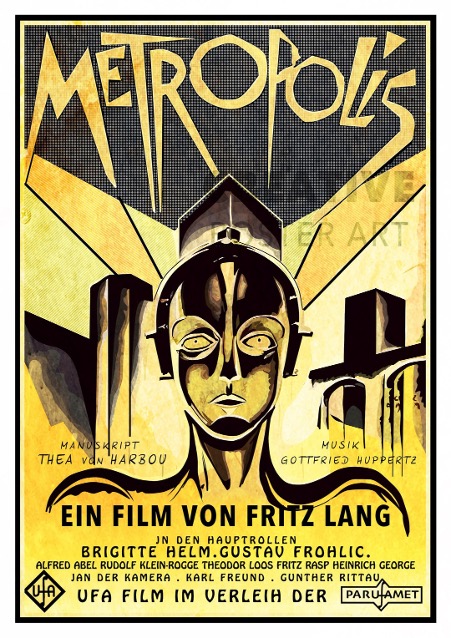
Cinema: Cinema has long made technically-constructed images serve as the final shot, from Fritz Lang’s Metropolis (1927) to contemporary CGI. Virtual production takes this further: it generates the shot in post production. Alex Proyas’ upcoming adaptation R.U.R is heavily reliant on virtual production, and the film collapses the distinction between live-action and animation. Actors perform within real-time rendered environments, turning capturing the moment into generating the moment.
Robots: As examples, art robotics reveals at least three distinct choreographies. Jordan Wolfson’s Body Sculpture function as a physical performance that looks almost like a film clip, executing a pre-rendered performance that never deviates from its program. In contrast, MSCHF’s Spot’s Rampage turned the robot into a proxy, transmitting the agency of distant internet users into physical space. Finally, the work of Mari Velonaki and Petra Gemeinboeck explores emergent movement, where the movement is not a script but a live negotiation generated in real-time between the machine and its human audience.
Research Questions
This thesis focuses on the creative labour behind mediated movement: how the ‘magic’ of animation is actually constructed across artistic fields.
Primary Question: What is the role of mediated movement in the process of creating movements, generating the illusions of life across these two distinct media forms: films and robots?
1. Cinema: How do filmmakers construct movement through technical means, and what does the concept of mediated movement reveal about this process?
2. Robotics: How do roboticists produce movement in physical space, and what does the concept of mediated movement reveal about the relationship between technical construction and the perception of lifelikeness in robots?
Conclusion
Ultimately, the fields of cinematic production and robotics engineering have unexpected commonality in their practices of mediating movement. By shifting focus from the finished illusion to the practices that craft it, we reveal a shared abstract machine. They are different dialects of the same language, mediated movement, and these media forms are the lingua franca of contemporary culture.
Leave a Reply