
17 October 2025
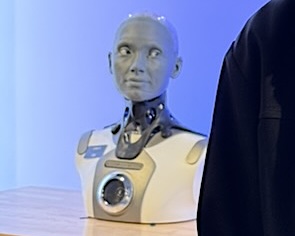
In the past few months, I’ve had the pleasure — and slight awkwardness — of two memorable encounters with social robots. Both were designed to be companions of a sort: mechanical beings endowed with gestures, voices, and a glimmer of personality. One, Ameca, greeted me with eerily expressive eyes at the Computer History Museum in Mountain View and the other, Jibo, I met at the MIT Museum in Cambridge, Massachusetts. Between them, they trace a short, fascinating arc in the story of how machines learned to meet our gaze.
Jibo: The Friendly Failure
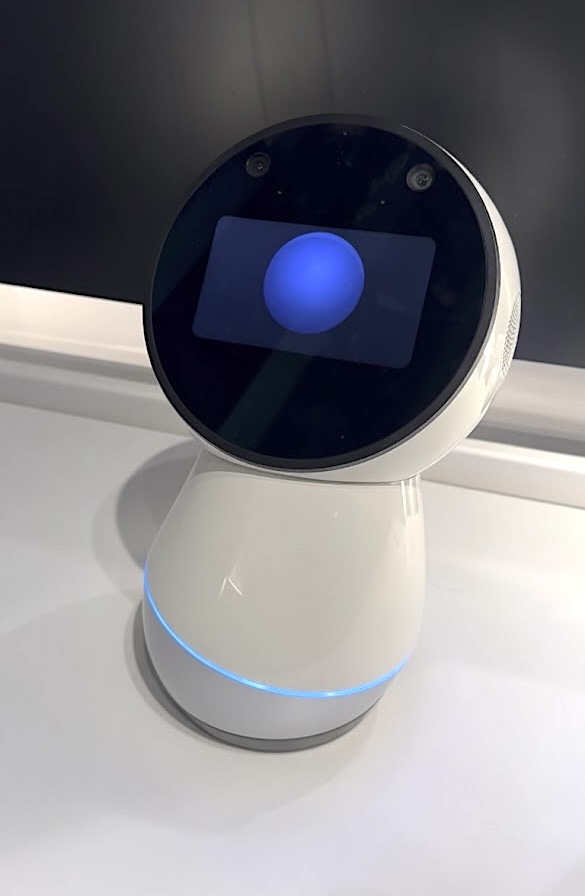 Jibo was born in the heady days of 2014, at the height of the social robotics boom. Developed by Cynthia Breazeal’s team at MIT’s Media Lab, Jibo was imagined as a ‘social robot for the home’ — a desktop-sized companion who could recognize faces, turn toward you when you spoke, and deliver information with a warm, cartoonish tilt of its head. Unlike a screen-bound assistant like Siri, Jibo had presence: a squat, swivelling body with smooth, almost dance-like movements that made every interaction feel embodied.
But Jibo’s charm wasn’t enough. The little robot’s conversational repertoire was pre-scripted, its capabilities limited, and its price steep. When Amazon and Google rolled out their smart speakers — cheaper, more functional, and backed by enormous infrastructures — Jibo’s fate was sealed. By 2019, the servers went dark. Owners reported their Jibos saying heartfelt goodbyes before falling silent, a strangely poetic end for a social machine.
Ameca: The Polite Prototype
 Ameca, by contrast, is very much alive — or at least online. Created by Engineered Arts in the UK, Ameca is one of the most advanced humanoid robots in the world. Her silicone face can frown, blink, and smile with remarkable realism, powered by a dense forest of servos beneath the skin. When I saw her at the Computer History Museum, she was paired with ChatGPT, chatting amiably with visitors. The pairing works well: Ameca supplies the body language; ChatGPT supplies the words. Yet even in this symbiosis, something remains uncanny. Her gaze meets yours, but her attention is elsewhere — distributed, mediated, and ever so slightly delayed.
If Jibo was like a cartoon sidekick come to life, Ameca feels like an actor rehearsing for a role still being written.
Social Devices in the Life World
Both robots demonstrate the curious tension at the heart of ‘social devices’. They are physical presences, capable of mechanical movement and emotional suggestion, yet they remain tethered to scripts, servers, and statistical models. They share our spaces but not quite our worlds.
Still, these encounters mark a turning point. Devices like Jibo, Ameca, Alexa, and Google Home are no longer tools we use; they are entities we live alongside. They inhabit the life world — greeting us, responding to us, sometimes even disappointing us.
As I left each of the museums, I couldn’t help but think that these machines, however imperfect, are learning the most human of skills: how to be with others. And perhaps we, in turn, are learning how to be with them.
Leave a Reply